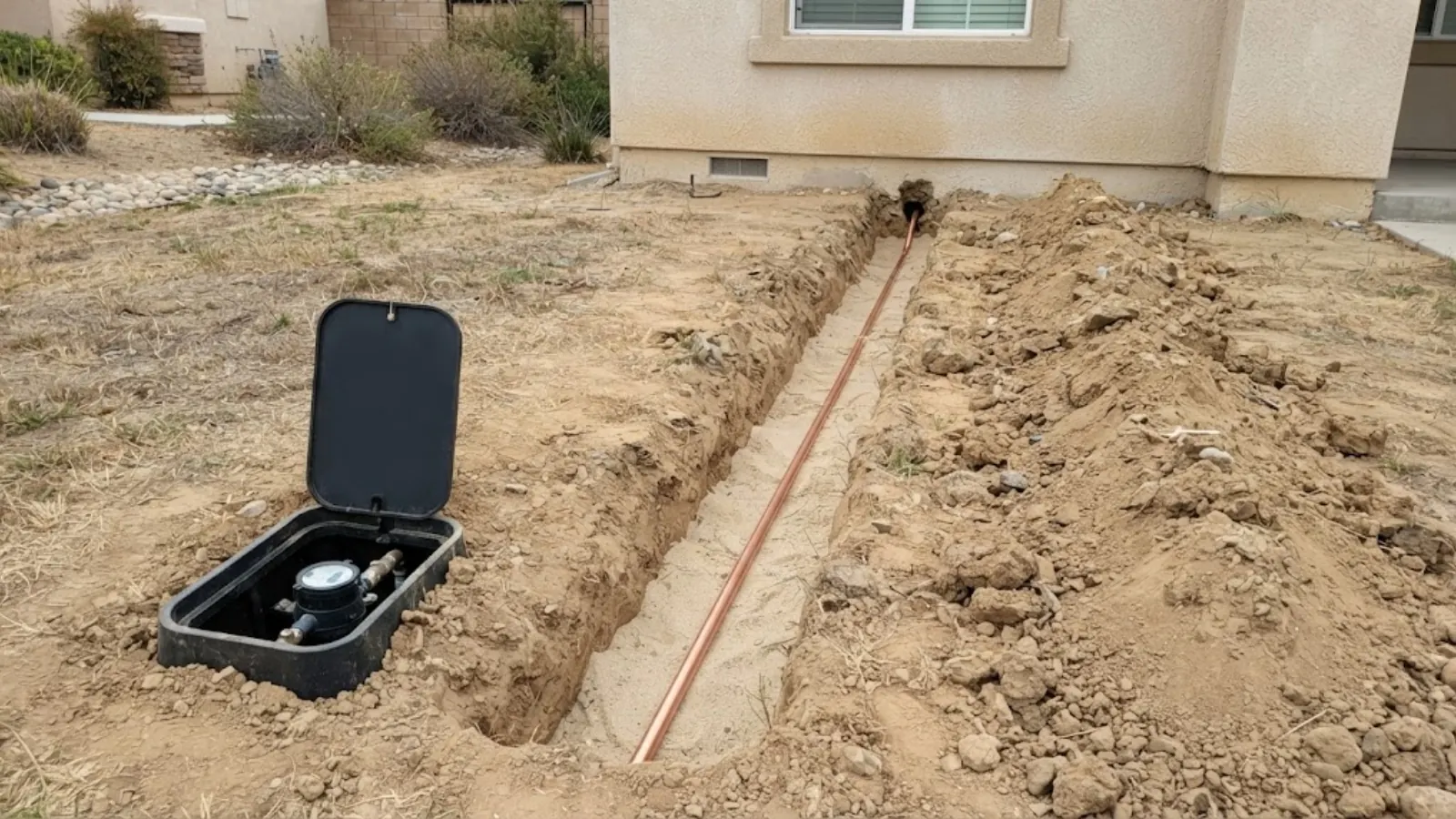
Is the leak yours or the utility's?
The water meter is the dividing line. Where the water shows up tells you who to call first.
| Where water appears | Likely owner | Call |
|---|---|---|
| Bubbling up in the street or gutter. | Water utility. | Mesa Water or IRWD. |
| Inside the meter box, at the meter. | Water utility. | Mesa Water or IRWD. |
| Soggy strip of yard between meter and house. | Property owner, in most cases. | A plumber. |
| At the house shutoff valve. | Property owner. | A plumber. |
Rules differ by utility, so confirm the exact handoff point with yours. Your water bill shows whether you are a Mesa Water or IRWD customer.
Emergency service line breaks: a wet yard or no water at all
A break in the line between the meter and the house usually shows up one of two ways. Water comes out of the ground and turns part of the yard into a swamp, or the pressure inside drops to almost nothing. Both are emergency calls, day or night.
If water is surfacing, close the house shutoff. If the break is between the meter and that shutoff, the Customer Control Valve at the meter is the one valve Mesa Water's rules let you operate. Anything on the street side of that valve belongs to the utility, so call Mesa Water at 949.631.1200 about leaks there.
We locate the break, expose it through the smallest opening we can, and repair it, or replace the run if the old pipe is failing along its length.
Confirm the leak is in the service line
A quick meter test separates a service line leak from a leak inside the house.
- Turn off all water use. Faucets, toilets, appliances and irrigation.
- Watch the meter. If the small leak indicator moves, water is escaping somewhere.
- Close the house shutoff. If the indicator keeps moving, the leak is between the meter and the house.
If the indicator stops when the house valve closes, the leak is inside. That is a job for leak detection.
Finding a buried leak before anyone digs
Many people know the leak is underground but not where. Plastic service lines are harder to trace than metal, because they carry sound and locating signals poorly. We use acoustic listening, tracing and pressure testing to narrow it down before any shovel goes in.
Signs on the surface help. A patch of lawn that stays greener than the rest, a soft spot in the grass, or water in the meter box that comes back after you bail it all point toward the route of the leak.
Digging blind along a long run wastes a day and a lawn. Locating first keeps the opening small and the repair priced to one spot.
Repair a section or replace the line
When the rest of the pipe is in good shape, we dig at the leak and replace a short piece. Older galvanized service lines are a different story. They tend to fail in several places and restrict flow to the whole house, so replacing the full run usually costs less than repeated digs.
A new line is also the moment to check water pressure. The California Plumbing Code, which is based on the Uniform Plumbing Code (UPC), requires a pressure reducing valve when incoming pressure is over 80 psi. We test it and replace or add the valve if needed, since high pressure shortens the life of every fixture.
Low pressure everywhere in the house, not just one fixture, often traces back to a corroded service line or a failing pressure reducing valve.
What the trench can run into
Service lines in older Costa Mesa yards often share space with sprinkler lines, landscape lighting, gas lines and tree roots. Mature trees are the most common complication, since roots grow along a leaking line toward the water.
Where the ground allows, a new line can be pulled through a narrow bore instead of an open trench, which saves lawns and walkways. Where it does not, we trench and restore the surface. Either way, the new line runs from the meter connection to a new house shutoff valve, so you end up with a shutoff that actually closes.
Before we dig
- Underground utilities are marked through the 811 call-before-you-dig system.
- We walk the line path with you to plan around trees, patios and driveways.
- Water is shut off only while the new line is connected.
- Irrigation lines crossed during the work are repaired before we backfill.
Low water pressure at every tap
Weak pressure at one faucet is usually that faucet. Weak pressure everywhere points to the service line, the main shutoff, the pressure regulator, or old galvanized pipe that has narrowed from the inside.
We start at the meter and work in. A gauge on a hose bib shows what the house receives, and a check at the regulator shows whether it has failed. If pressure is good at the meter and poor inside, the pipe itself is the restriction.
A sudden drop with no warning is different. It often means a break somewhere on the line, so look for wet ground and call right away.
What water line repair costs
Service line work is priced by length, depth and what sits on top of it.
| Factor | Why it matters |
|---|---|
| Repair or replace | A spot repair costs far less than a full new line. |
| Length and path | Longer runs and lines under driveways or patios cost more. |
| Surface restoration | Concrete, pavers and landscaping must be put back. |
| Pressure valve | Replacing a reducing valve adds parts and labor. |
| Timing | An active leak at night costs more than a scheduled repair. |
Insurance note: many homeowner policies exclude underground service lines unless you have a service line endorsement. Check before the work begins.
Want your real number? Call (714) 750-8637 and describe the job.
Service line work nearby
We repair and replace water lines across 92626 and 92627 and in nearby cities like Santa Ana. When the problem is the pipes inside the walls, see whole-home repiping.